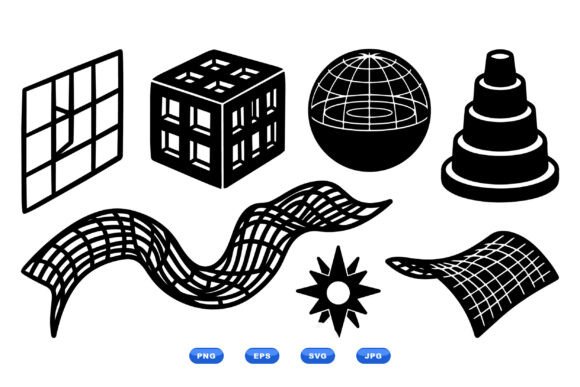
3D Geometric Grid Clipart for Design
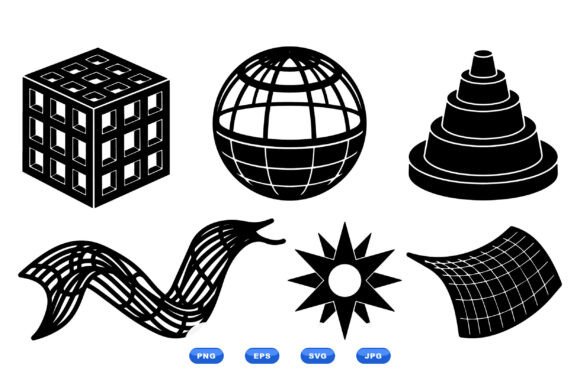
In the crowded landscape of digital visuals, clarity often cuts through the noise more effectively than complexity. A bold black line art collection featuring geometric grids, cubes, spheres, layered cones, and flowing warped surfaces offers exactly that kind of visual punch. This specific style of 3D Geometric Grid Clipart strips away color to focus entirely on structure, form, and contrast. By utilizing pure black and white imagery with high-contrast lines, designers can create assets that remain sharp and legible at any scale, from a tiny mobile app icon to a massive billboard.
The appeal of this aesthetic lies in its versatility. It bridges the gap between technical precision and artistic abstraction. Whether you are a brand manager looking for a modern logo mark or an educator needing clear diagrams, these vector-based resources provide a foundation that is both robust and adaptable. Because the artwork is delivered as 100% vector SVG and EPS files, the integrity of the lines never degrades. This ensures that your final output remains crisp, professional, and ready for print or screen without the pixelation issues common in raster images.
Understanding the Power of Vector Geometry
At its core, 3D Geometric Grid Clipart represents a return to fundamental design principles. The use of grids, cubes, and spheres taps into our innate understanding of space and dimension. When rendered in bold black lines, these shapes communicate stability, logic, and order. However, the inclusion of flowing warped surfaces introduces a dynamic element, suggesting movement, fluidity, and transformation within a rigid framework.
This duality makes the collection particularly interesting for contemporary design. The stark contrast between the structured grid and the organic warp creates visual tension that captures attention. Unlike flat design trends that rely heavily on color gradients, this approach uses line weight and negative space to define depth. For professionals working in branding or editorial design, this means you can achieve a three-dimensional look without relying on heavy shading or complex rendering techniques that might slow down load times on the web.
The technical advantage cannot be overstated. Since the download includes a ZIP folder containing SVG, PNG, JPG, and EPS files, you have immediate access to formats suitable for every stage of production. The SVG and EPS files allow for infinite scalability, meaning a cube designed for a business card can be enlarged to cover a storefront window without losing definition. The PNG and JPG options provide quick compatibility for social media posts or presentations where vector editing isn't required.
Creative Applications for Modern Projects
The potential applications for this line art collection are vast, extending far beyond simple illustrations. Here is how different creative professionals can leverage these assets to elevate their work:
- Brand Identity and Logos: Many tech startups and consulting firms seek logos that convey innovation and structure. A single cone or a section of a warped grid can serve as a powerful monogram or icon. The bold lines ensure the logo remains recognizable even when reduced to a favicon size.
- Pattern Design: By repeating elements like cubes or spheres, designers can create seamless patterns for packaging, textiles, or website backgrounds. The high-contrast nature of the art allows these patterns to be overlaid with text or other graphics without becoming visually muddy.
- Editorial and Infographics: For bloggers and publishers, these shapes act as excellent visual anchors. A sphere can represent a global concept, while a grid can symbolize data or organization. They break up walls of text and guide the reader's eye through complex information.
- Presentation Decks: Marketers and entrepreneurs often struggle to find unique visuals for slides. These clean, abstract shapes add a layer of sophistication to pitch decks, making them stand out from standard stock photography.
Consider a scenario where a small business owner needs to rebrand their packaging. Instead of using generic photos, they could overlay a flowing warped surface behind their product name. The black-and-white aesthetic keeps the focus on the typography while adding a sense of depth and modernity. Similarly, a freelancer designing a portfolio website could use the geometric grids as subtle background elements to create a cohesive visual theme across all pages.
Adapting Assets for Different Audiences
One of the greatest strengths of 3D Geometric Grid Clipart is its neutrality. Because the artwork is devoid of color and cultural specifics, it can be adapted to suit almost any audience or industry. The key lies in how you manipulate the context around the shape.
For a youthful, energetic audience, such as a gaming community or a streetwear brand, the warped surfaces can be emphasized. Pairing these fluid shapes with bright, neon accent colors can create a futuristic, cyberpunk vibe. The black lines provide the necessary structure to prevent the design from feeling chaotic.
Conversely, for corporate clients or educational institutions, the rigid cubes and grids take center stage. These shapes suggest reliability and precision. Keeping the palette strictly black and white, perhaps with a single accent color like navy blue or forest green, reinforces a message of professionalism and trust. Educators can use the layered cones to explain mathematical concepts or architectural principles, providing students with clear, uncluttered visual aids.
Freelancers and content creators should also consider the platform. On Instagram or TikTok, where attention spans are short, the boldness of the line art ensures the image pops on small screens. In print publications, the vector quality guarantees that the details remain sharp under high-resolution scrutiny. The ability to switch between formats easily means you don't need to recreate assets for every medium; you simply choose the right file type from the provided ZIP folder.
Maintaining Consistency and Clarity
While the flexibility of these resources is a major benefit, it requires discipline to maintain a consistent visual identity. When incorporating 3D Geometric Grid Clipart into a larger project, it is crucial to establish a set of guidelines early on.
First, decide on a hierarchy of elements. Will the grids serve as backgrounds, or will they be the primary focal point? Mixing too many different shapes—cubes, spheres, and cones simultaneously—can lead to visual clutter. Selecting a subset of the collection for a specific campaign helps create a unified look. For example, a series of blog posts might all feature variations of the warped surface to signal a thematic connection.
Second, pay attention to spacing and alignment. The strength of geometric art lies in its precision. Ensure that there is adequate negative space around the shapes to let them breathe. Overcrowding the canvas can diminish the impact of the bold lines. Use the grid lines themselves as guides for aligning text and other graphical elements.
Finally, remember that simplicity is the ultimate sophistication. Resist the urge to over-edit the vector files. The original design has been crafted to balance complexity and clarity. Adding unnecessary effects or distorting the proportions can undermine the professional quality of the artwork. Trust the inherent strength of the bold black lines to do the heavy lifting.
Practical Recommendations for Implementation
To get the most out of this resource, start by organizing your files immediately upon download. Create a dedicated folder structure for your SVGs, PNGs, and EPS files. This saves time during the design process and ensures you always have the correct resolution available. If you are working in Adobe Illustrator or similar vector software, keep the master EPS or SVG files editable so you can adjust line weights or combine shapes if needed.
Experiment with layering. One effective technique is to place a semi-transparent color block behind a black line art shape. This adds depth and color without obscuring the detail of the lines. Alternatively, try placing the geometric shapes over a textured paper background to give a tactile, hand-drawn feel to digital projects.
For those new to vector design, the included PNG files offer a low-barrier entry point. You can drop these directly into Canva, PowerPoint, or Google Slides to instantly upgrade the look of your documents. As you become more comfortable, transition to the vector formats to unlock full customization capabilities.
Ultimately, this collection of 3D Geometric Grid Clipart is more than just a set of images; it is a toolkit for visual communication. It empowers creators to build designs that are structurally sound, aesthetically pleasing, and functionally versatile. By embracing the boldness of black and white and the precision of vector geometry, you can produce work that stands the test of time and resonates with audiences across all platforms.